Saturday, December 3, 2016

Video Game

Arrogance—The only dependable thing about the future is uncertainty.
Amarant's quote


Amarant Coral nicknamed The Flaming Amarant or Red, and also known as Scarlet Hair, is a playable character from Final Fantasy IX. He is introduced to the player as Red-headed Man before his name can be chosen.

Amarant appears in-game as a tall man with red dreadlocks, a red chinstrap beard and bluish skin. His outfit consists of a green vest and trousers, a red belt round his waist, red bands on his upper arms and green bands on his wrists, and brownish-red boots.

A rather arrogant man who fights with the honor of a warrior, Amarant also seems a little naive, confused at Zidane's actions throughout the game, and follows him to understand more. He is enigmatic and rarely opens up.

Covers

1906
‘Le Petit Larousse IllustrĂ©’, a single-volume encyclopaedia, is published for the first time.


 1904
"Woman" magazine with a cover design by Septimus Bennett, younger brother of Arnold Bennett, the Potteries novelist and the magazine’s former editor


Post XX - Fashion Design

France's Academic Dress - Science Field

Most people think that graduation ceremony is an original tradition from the Anglo-Saxons, but it was actually in France, University of Paris, where students established this tradition in the early Renaissance. The academics caps and gowns were first used by students and teachers of the universities to keep them warm in unheated buildings. This practice disappeared in May 1968 but has been now brought back to many schools and universities, combining tradition and modernity, to celebrate graduation, exalting:

- Completion of several years of effort, the transition into the professional world and thus immense pride for the student and for his relatives 
- brand image and prestige of a school. 


The full costume is:


  • dress: rather like a cassock , she runs in front of a row of buttons (black or specific color) and lagging behind
  • robe: two vertical strips of fabric on either side of the buttons or the specific color or black moire;
  • an epitoge: a strip of cloth from the specific color attached by a button at the left shoulder, with a wide and triangular end (in the rear) and a longer, narrow end (the front), each end with one to three rows of ermine according to the rank of the wearer;
  • a belt identical to that of the Roman Catholic church: long and wide, it is finished in fringes (gold or the specific color), and features a large ornamental knot and a long end hanging down in front of the costume on the left ;
  • a flap white: it is a kind of Baptist jabot or lace according to the rank of the wearer, over which men can wear a white bow tie for very formal occasions;
  • a toque (normally reserved only for men, and never worn on the head but hand held) with stripes and loops depend on the rank of the wearer;
  • white gloves


In the French academic dress system, the five traditional fields of study (Arts, Science, Medicine, Law and Divinity) are each symbolized by a distinctive color, which appears in the academic dress of the people who graduated in this field. Amaranth is the distinctive color for Science. University rectors, chancellors or presidents wear also specific costumes, which are violet regardless of the academic field in which they graduated.

Field of graduationColour nameColour aspect
Divinity (and all high officials regardless of the field)Violet (Purple, specifically the Royal Purple shade)
Law (colour also worn by high magistrates)Écarlate (Scarlet)
Medicine (and health-related fields)Groseille (Redcurrant, a reddish shade of pink)
Science (exact and experimental)Amaranthe (Amaranth)
Arts, literature, philosophy, humanitiesJonquille (Daffodil, a shade of yellow)

For science faculties: amaranth silk dress, gown in black silk flap batiste, silk shoes in amaranth with three rows of ermine, ribbon belt with fringed amaranth and amaranth cables in silk hat in amaranth silk with a lace Golden;


  • Small suit: black muslin dress with lapel crimson silk gown and black silk.

Post XIX - Anatomy

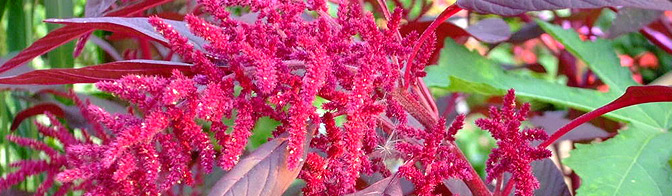
Hello everyone, I am Amaranth. 

You probably never heard my name before. And if you have, I'm pretty sure you think you can eat me. That's not true though. You can eat something produced by my mother, the Amaranth plant. She's beautiful and brightful and that's where I get my name from. I'm actually a color, nice to meet you! The same way I got my name from my mom, my color is in honor of her as well. Even though I was born in the English language in 1690, not many people know about my existence so I'm going to explain you my anatomy based on people's senses, hope you are interested. 


 If you want to create me from scratch, with your own hands, using your touch sense I can be reached starting with the primary color red (paint) and being added to that a bit of black depending on the shade you want to achieve. I'm so eclectic that once you get to this mixture you can create the variations you like: if you want me to be lighter, add some blue; if you want me to be darker, add some yellow.


Even though it's super easy to create me, it's not that easy to see me (at least that's what scientists say, but I'm pretty much every where, you just have to pay attention!!) The color is assimilated by the human body through the vision, which is the sense that takes the information more quickly to the brain. By that means, that it has an immediate stimulus and the color will lead to various reactions on the observer (positive or negative).

The amaranth color can be seen when the red-sensitive cones of our eyes are activated, together with some of the green and the blue, generating the pink colors.


The pink shades 


  • Bright pinks, like the color red, stimulate energy and can increase the blood pressure, respiration, heartbeat, and pulse rate.
  • They also encourage action and confidence.
  • Pink has been used in prison holding cells to effectively reduce erratic behavior.


On the taste sense and on the smell senses, I like to think about myself according to my origins. As I said before, I come from a flower, so my smell is very delicate and flowery. Close your eyes and imagine yourself in a field full of amaranth flowers, isn't it peaceful and mind opening? Ok, so this flowers are also going to give you lunch, because that's how we like to be, we like to fulfill all your needs. We also thing about your healthy, so don't worry you'll be receiving a lot of nutrients and no fat!!


And I think that's all folks. I hope you got to understand a bit more about me and please look around for me I'm really looking forward to meeting you more often!


Monday, November 21, 2016

Post XVIII - Painting

 “… repulsively real ballet girls [but] magnificently brushed in.”
Anonymous 

The chosen painting is denominated as Dancers in Pink by Edgar Degas. Degas is often associated with images of ballerinas in various stages of relaxation, preparation and dance. In this painting, none of the dancers are looking at the viewer, making it clear that the interlocutor is getting inside of the ballerina's world, they're just visitors and cannot interrupt. 

Dancers in Pink
Edgar Degas
1880-1885
Oil on Canvas
Hill-Stead Museum, Farmington, CT


The brush strokes on the tutus make them look soft and sweeping. Their dresses are in a pinkish-amaranth color making them full of weight. Degas represented poor young girls that struggled to become the fairies, nymphs and queens of the stage.


Post XVII - Patents

Blood Gas ControlUS4001142A
Publication Date - 1977-01-04
Inventor - James E. Turner, United States of America 


This patent is about a packaged and convenient trilevel control system for monitoring laboratory measurement of pH, Po2, and Pco2 with blood gas analyzing instruments. The object of this invention is to prepare a stable, aqueous solution possessing chemically significant values for pH, partial pressure of oxygen (Po2), partial pressure of carbon dioxide (Pco2) and bicarbonte concentration [HCO3 -] to be used as a control for monitoring instruments that measure these parameters. In simplest terms, what is disclosed is a satisfactory, color coded liquid control for pH, Po2, and Pco2 at three levels (alkalosis, acidosis, normal) free of all proteins. The three controls, in ready to use liquid form, are formulated to simulate physiological levels over the clinically significant range of acid base respiratory balance and function.


The liquid blood gas control of this invention is thus designed to react in like manner as blood. Whatever parameters may effect whole blood readings in the blood gas instrument, will also effect similar changes in the control. If a human error or mechanical error exists which effects the pH, Po2, or Pco2 of the blood, that error will also effect the blood gas control since both systems are the same. Another problem that was encountered in the development of the liquid blood gas control of this invention was the instability of certain dyes on exposure to direct sunlight. This was particularly true of several blue and red dyes tested for use in the alkalosis and acidosis controls. The instability of the dye was also accompanied by a decrease in the Po2 value. Apparently a light catalyzed oxidation was occurring which did not take place at a detectable rate in the dark. This problem was solved by the careful selection of suitable dyes for all three control levels.

One purpose for which the dyes were added to the control was to afford a visual discrimination between the various control ampuls. To agree with conventional acid base litmus color standards, a preferred color of the normal control would be yellow, for the acidosis the color control would be red, and for the alkalosis, the color control would be blue.

The dyes selected as showing the greatest amount of stability within this liquid gas control system were F, D and C yellow, amaranth al lake, and alphazurine FG dyes. The yellow dye which is the trisodium salt of 5-oxo-1-(p-sulfophenyl)-4-[(p-sulfophenyl)azo]-2-pyrazoline-3-carboxylic acid, was found to be chemically stable in all levels of the standard. The amaranth dye was used to give the red color to the acidosis control. The alphazurine dye was used to yield the blue color in the alkalosis control.

Step XVI - In Design

The design I chose to talk about is made by Karim Rashid, an industrial designer who has created almost every piece of home equipment there is to design, from a salt shaker to sofas and light fixtures. He is also an architect, a decorator, a lecturer, a writer, an artist, even a fashion designer, and a DJ. Rashid is also famous for turning pink into a manly color. He often chooses to wear it himself and his style of clothing is throughout to the last detail. 

Kouple Bathtub and Sink is set designed for the bathroom environment. Their design blend modern technology and aesthetic appearance. Even though they are part of the same collection, they are sold separately by the same producer, Saturn Bath Co. Founded in 1990, Saturn is a South Korean based company that produces acrylic bathtubs exclusively, with over 100,000 bathtubs produced every year. The company is a specialist in manufacturing bathroom cabinets, shower booths, bidet, system furniture and other bathroom furniture.
                   
Double cavity bathtub with ergonomic seating comfort

Size _ 1,700 x 1,000 x 525 mm
Material _ Liquid Acrylic Resin, Cast
Designed by Karim Rashid
Produced by Saturn Co., Ltd.


The bathtub shape is inspired in a waterdrop letting the natural curved line complete the design with harmony. It's made of liquid acrylic resin (LAR). LAR is known for its antibacterial qualities, durability, high gloss and rich texture. 

Wall mounted double sink
Flat surface with curved bottom and basins
Size _ 1,150 x 500 x 215 mm
Material _ Liquid Acrylic Resin, Cast
Designed by Karim Rashid
Produced by Saturn Co., Ltd.


The Kouple bathtub can also be paired with a matching Kouple sink, which mimics the shape of the tub with two faucets installed being designed for two people and, of course, is in Rashid's signature pink.